Unless you have been sleeping under a rock the last few years you will have seen quite a lot pop up on your newsfeed’s about Artificial Intelligence or AI with some predicting the end of the human race and others sharing the view that it could be our saviour, albeit a hybrid version of ourselves.
For those of you who don’t know what AI is according to Wikipedia.
Artificial intelligence (AI, also machine intelligence, MI) is apparently intelligent behaviour by machines, rather than the natural intelligence (NI) of humans and other animals. In computer science AI research is defined as the study of “intelligent agents”: any device that perceives its environment and takes actions that maximize its chance of success at some goal. Colloquially, the term “artificial intelligence” is applied when a machine mimics “cognitive” functions that humans associate with other human minds, such as “learning” and “problem solving”
The world is facing many challenges right now from global climate change to the ever widening gap between the rich and the poor, looming implosion of the banking system as we know, food insecurity, potential war between the new and old super powers again, marginalisation of minority groups, ever threat of terrorism, water as a resource becoming more precious now than ever, deforestation and the exploration of our oceans which is pivotal to our survival and the list goes on depending on your perspective and circumstance.
The question is how will technology impact or disrupt all of the above and will it provide an answer to what sometimes seems very overwhelming.
Will it save us or will it see the end of “us” as a species,
Is this the next stage of our evolution?
Already we are seeing that advancements in technology are improving our lives there are certain yet to be discovered technologies that are going to see a quantum leap forward and change our lives as we know it, very quickly. Can we adapt is the question.
There are many futurists that believe that AI will take a huge jump forward past the human races ability to comprehend or control it. The scenes from Terminator could become something of the future. Man vs Machine?
When i started writing this piece I didn’t want it to become a Dooms Day prophecy, although the potential is always there. We are extremely interested in how technology is going to solve some many of the worlds challenges potentially very quickly.
There are many experts that believe that machines will reach human levels of intelligence by 2029, moving faster towards Singularity.
However, what if we look at it another way. Everything will change, they way we work, the concept of jobs as in 9 – 5 could be a thing of the past. In fact everything we know now which define (we think anyway) us like careers, how much we earn, where we live, keeping up with the Jones’s will change and could be replaced by machines working for us which in fact will actually give us the time and space to really live our lives the way we are supposed to, the previous industrial revolution created this idea that we must work ourselves to the bone for some corporation to enrich the few and enslave the masses, for what?
There could be a time where we live and work in unison with machines to help shift the way things have worked previously. Live more work less, doesn’t sound so bad to me as long as we can adapt to these changes and make sure they always have the right outlook in terms of why are we doing this?
So why am I written about this?
Bigger Than Me is a social change agency and we work in the cause marketing sector but specifically in digital and the world of digital is where all of these major exponential tech inspired changes and growth is going to come from which will lead to solving a lot of the worlds challenges. So how are these changes going to be affecting the work we do and how can we prepare for these changes and even lead them?
How does this impact marketing?
How does it impact the NGO space?
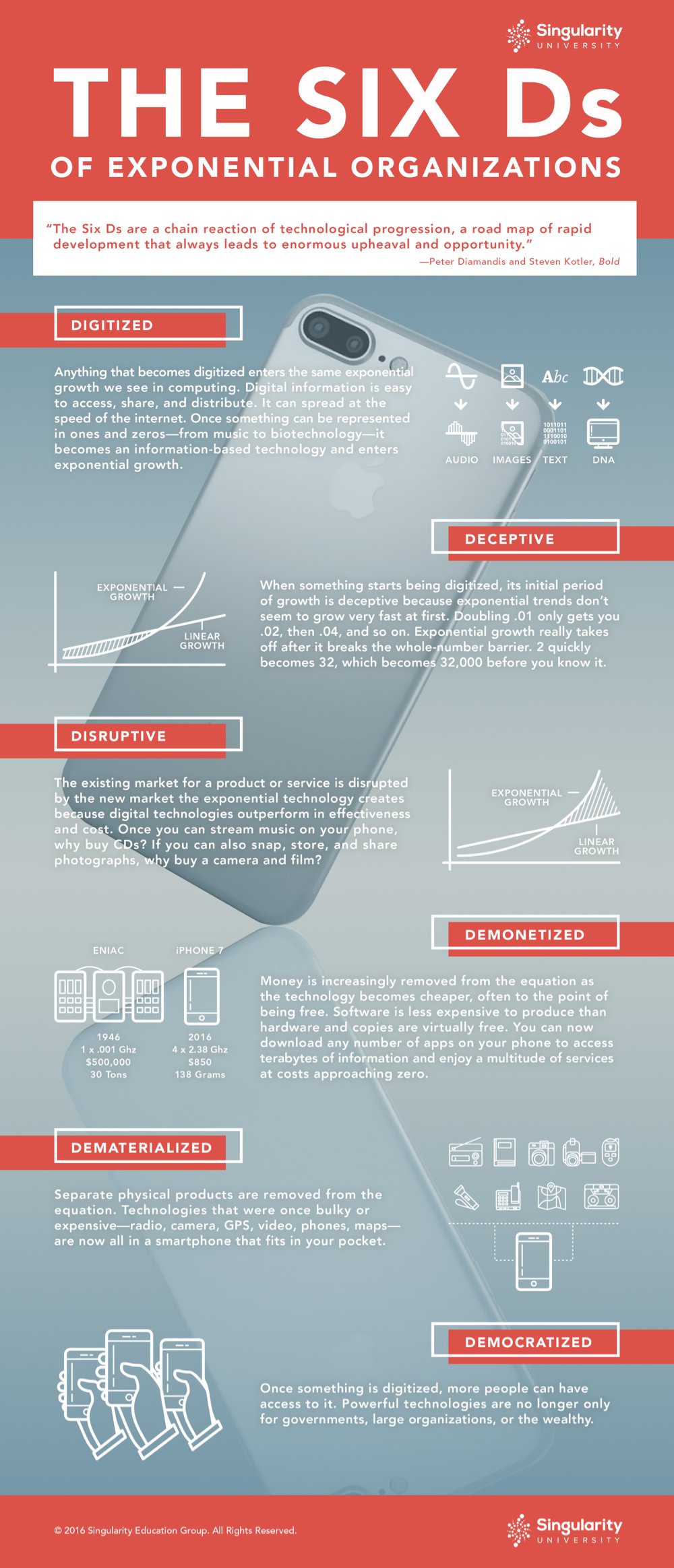
Peter Diamandis, co-founder and executive chairman of Singularity University, gives us an idea of what to expect in the future and that exponential growth of disruptive digital technologies will follow six steps or the “6D’s” which every organisation that plans to innovate in a digital economy should start to very seriously look at or get left behind and thats really important for the space we operate in, the “For Good” sector. Its also something NGO’s need to think about. How is this new technology going to help us do our jobs better and easier with greater impact?
We have already seen this in technologies like solar and wind energy where the cost outweighed the production but now thats shifted where the tech is now cheaper and the resource becomes more viable.
Could new technologies help NGO’s tell their stories better, quicker and cheaper?
Could drone technology help communities grow their food more efficiently?
What could nano technology do for medical science?
How will digital disruption impact how brands communicate?
What shared value technologies will be created to help poor people get jobs and still make a profit?
How will Bitcoin and other Crypto digital currencies cut out the established banking world creating a freer economy?
We have some ideas of our own but it does create very exciting dynamic potential.
Food for thought!!!
The 6D’s look like this from the Singularityhub.com