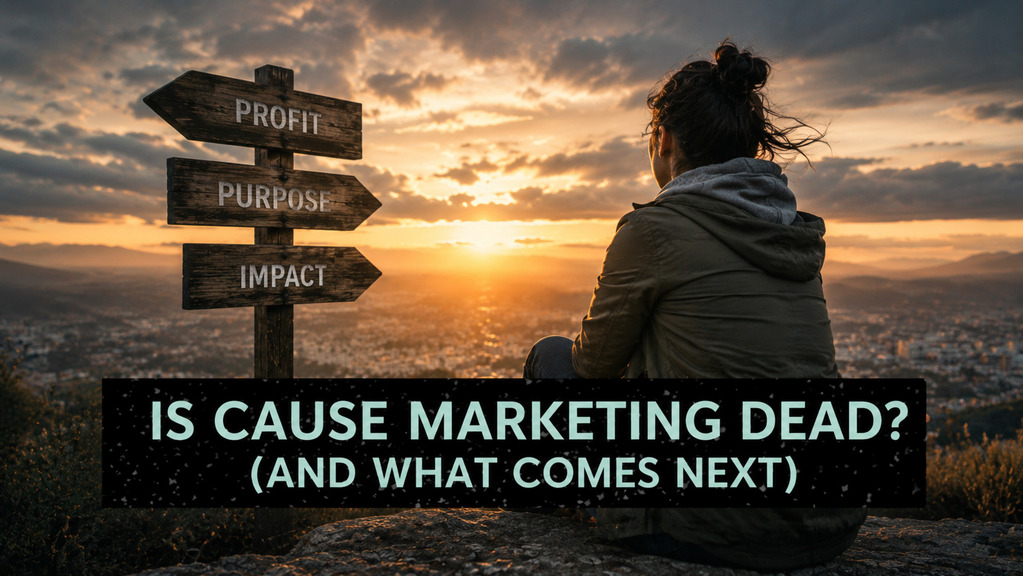
Why trust, AI and the creator economy are reshaping social impact marketing
For years, cause marketing occupied a unique position in the marketing world.
It sat at the intersection of business objectives and social impact. It helped brands connect with purpose, gave NGOs access to new audiences, and created opportunities for consumers to support causes through the products and services they purchased.
At its best, cause marketing created genuine value for everyone involved.
At its worst, it became little more than a campaign.
Today, as audiences become increasingly sceptical of corporate messaging, AI-generated content floods digital channels, and creators become trusted sources of information, many organisations are asking a difficult question:
Is cause marketing dead?
The short answer is no.
But the version of cause marketing that dominated the past decade is rapidly losing relevance.
What is cause marketing?
Cause marketing is a strategy where a brand aligns itself with a social, environmental, or community cause to create both business and societal value.
Traditionally, this has included:
- Brand and NGO partnerships
- Cause-led awareness campaigns
- Donation-linked purchases
- Community development initiatives
- Purpose-driven brand positioning
For many years, these approaches were highly effective. Research from Cone/Porter Novelli, Edelman, Deloitte, and Nielsen consistently demonstrated that consumers were more likely to support brands that reflected their values and contributed positively to society.
The challenge is that what worked ten years ago doesn’t necessarily work today.
Cause marketing didn’t fail. It scaled.
One of the reasons cause marketing feels less effective today is because it became mainstream. Almost every major brand now has a purpose statement, an ESG strategy, a social impact programme, and a sustainability narrative.
While this increased awareness of important issues, it also created a new problem.
When everyone stands for something, standing for something is no longer a competitive advantage. Purpose became part of the marketing playbook. And audiences noticed.
As a result, consumers have become increasingly skilled at identifying the difference between authentic commitment and performative participation. The question has shifted from ‘What does this brand stand for?’ to ‘Can this brand prove it?’
The trust crisis behind modern cause marketing
The biggest challenge facing cause marketing today is not awareness. It is trust.
Audiences are exposed to thousands of marketing messages every day. They have learned to recognise purpose-washing, short-term campaigns disguised as long-term commitments, stories disconnected from lived experience, and impact claims without evidence.
This growing scepticism creates a difficult reality for brands and NGOs alike. Credibility has become one of the most valuable assets an organisation can possess. And credibility cannot be manufactured through communications alone. It must be earned through action.
Why NGOs need to rethink storytelling too
The conversation around cause marketing often focuses on brands. However, NGOs and social impact organisations face many of the same challenges.
In many cases, genuine impact exists on the ground, but the way it is communicated feels disconnected from reality. Common issues include over-sanitised storytelling, limited content production capacity, dependence on occasional campaigns, lack of distribution strategy, and over-reliance on traditional donor communications.
The result is often a disconnect between the reality of the work and the perception of the work. Real impact can struggle to gain attention in a digital environment increasingly shaped by creators, communities, and algorithmic distribution.
How the creator economy changed trust
Perhaps the biggest shift in the last decade has been the rise of the creator economy.
For generations, institutions controlled information. Today, trust increasingly resides with individuals — creators, community leaders, subject matter experts, and people with lived experience — far more than it rests with corporate messaging alone.
This changes the dynamics of cause marketing significantly. The most effective stories are often no longer being told by organisations. They are being told by the people closest to the issue.
User-generated content often outperforms traditional advertising. Community-driven storytelling generates higher engagement. Creator-led campaigns create stronger emotional connection. The future of cause marketing is likely to be less about controlling narratives and more about enabling participation.
The AI paradox
Artificial Intelligence is creating both enormous opportunities and significant risks for the future of cause marketing.
On one hand, AI can help organisations create content more efficiently, improve reporting and impact measurement, translate and localise communications, analyse audience behaviour, and increase operational capacity.
On the other hand, AI introduces a fundamental trust challenge. As synthetic content becomes easier to create, audiences become less certain about what is real.
The more artificial content enters the ecosystem, the more valuable authentic human stories become.
Organisations that succeed in the AI era will likely use AI as an operational tool while ensuring that human experience remains at the centre of their storytelling. AI can help tell stories. It cannot replace lived experience.
Why Mobile Journalism (MOJO) matters
One of the most important developments in modern storytelling is the rise of Mobile Journalism — often referred to as MOJO.
Traditionally, impact stories were captured by professional production teams visiting communities periodically. Today, smartphones enable organisations to build continuous storytelling systems. This allows community members, beneficiaries, field workers, staff members, and local creators to capture stories in real time.
The significance of this shift cannot be overstated. The future of cause marketing is unlikely to be driven by better campaigns. It will be driven by better content capture systems. Organisations that build the capability to document impact continuously will have a significant advantage over those relying solely on periodic campaigns.
Measuring what actually matters
Many campaigns continue to focus on outputs — reach, impressions, views, engagement. While useful, these metrics do not necessarily indicate meaningful impact.
Future-focused organisations will increasingly need to focus on outcomes: behaviour change, increased participation, improved trust, service uptake, fundraising performance, and policy influence. The future of cause marketing will require stronger links between storytelling and measurable action.
Why this matters in South Africa
South Africa presents a unique context for cause marketing. Issues such as inequality, unemployment, education, healthcare, and service delivery are highly visible and deeply personal.
As a result, audiences often have a lower tolerance for superficial purpose messaging. In many developed markets, authenticity may be considered a differentiator. In South Africa, authenticity is increasingly becoming a baseline expectation. Organisations that fail to demonstrate genuine commitment risk losing credibility quickly.
The future of cause marketing
Cause marketing is not disappearing. It is evolving. The next generation of cause marketing will likely be defined by:
- Authenticity at scale — real people sharing real experiences
- Creator-led trust — community voices becoming central to storytelling
- AI-assisted operations — using AI to enhance communications while preserving human authenticity
- Mobile Journalism — building continuous content ecosystems rather than isolated campaigns
- Measurable outcomes — moving beyond awareness metrics toward tangible impact
- Participation over awareness — inviting audiences into the work rather than simply informing them about it
The work has to be real before the amplification starts.
Cause marketing is not dying because people care less. It is changing because audiences have become more sophisticated. They want evidence, not promises. Participation, not performance. Transparency, not perfection.
The organisations that succeed in the years ahead will not necessarily be the ones with the biggest campaigns. They will be the ones willing to do the work, show the work, and allow others to tell the story.
Because in a world increasingly shaped by AI, creators, and algorithmic discovery, credibility remains one thing technology cannot manufacture.
It has to be earned.
Sources & further reading
Edelman Trust Barometer (2024–2025) · Deloitte Global Gen Z & Millennial Survey · Cone/Porter Novelli Purpose Study · McKinsey & Company – ESG and Long-Term Value Creation · Harvard Business Review – Purpose-Driven Brands · Nielsen Trust in Advertising Report
We would love to hear from you.
Connect with Bigger Than Me